




Discover how Fractional CMOs help businesses grow through clearer strategy, stronger leadership, better investment decisions and more capable marketing teams.


Introduction
Growth is often discussed as though it were primarily a question of marketing activity.
Generate more leads. Launch more campaigns. Enter more channels. Produce more content. Increase awareness.
Yet businesses rarely struggle to grow because they have run out of activity. More often, they lack sufficient clarity about where growth should come from, which customers matter most, how marketing should support the commercial strategy and what deserves investment.
The resulting problem is not inactivity but fragmentation.
Marketing becomes a collection of campaigns, suppliers and initiatives without a sufficiently strong organising idea. The team remains busy, but leadership cannot confidently explain what is driving performance, where resources should be concentrated or why results are becoming harder to predict.
A Fractional Chief Marketing Officer (CMO) addresses that leadership gap.
Rather than operating as an external commentator, a Fractional CMO joins the senior leadership environment for an agreed proportion of their time. They bring executive-level marketing judgement into the business, connect marketing with commercial priorities and create the discipline required to turn activity into a more coherent growth system.
Their contribution is not defined by the number of days they work. It is defined by the quality of the decisions they improve.
Growth Depends on More than Marketing Activity
Sustainable growth is produced by a series of connected choices.
The business must decide which markets to pursue, which customers to prioritise, how it should differentiate itself and which proposition is most likely to command attention and preference. It must translate those choices into a practical route to market, align sales and marketing around shared priorities and invest in the people, systems and channels required to deliver.
Weakness in any part of this system can constrain the whole.
A strong product may fail to gain traction because its value is poorly articulated. Demand generation may create volume but insufficient commercial quality. Sales and marketing may pursue different definitions of the ideal customer. Agencies may execute competently against an unclear brief. A capable marketing team may be working without the senior leadership needed to establish priorities and challenge the wider business.
Adding more activity to this environment usually increases cost and complexity before it improves performance.
A Fractional CMO helps the leadership team step back from individual tactics and assess the growth system as a whole. Their role is to identify where momentum is being lost, clarify the choices that matter and create the conditions in which marketing can make a more reliable commercial contribution.
How a Fractional CMO Creates Leverage
The value of fractional leadership is not proportional to time spent in the business.
An experienced marketing leader may influence a relatively small number of decisions, but those decisions shape the work of internal teams, agencies, sales colleagues, product leaders and external suppliers. Improving them can therefore create an effect far beyond the Fractional CMO’s direct capacity.
This leverage usually begins with three interventions.
- Strategic clarity. The Fractional CMO helps the business decide where it will compete, who it must influence and how it intends to create preference.
- Prioritisation. Competing initiatives are assessed against commercial objectives so that resources are concentrated rather than distributed across an expanding list of possibilities.
- Governance. Clear responsibilities, measures and decision-making rhythms are introduced so that the strategy continues to guide the organisation after the initial planning work has been completed.
Together, these interventions change how marketing operates. Teams understand what matters. Agencies receive clearer briefs. Budgets are easier to defend. Performance discussions become more commercial and less reliant on activity metrics.
Less unnecessary work is commissioned, while the work that remains has a stronger chance of contributing to growth.
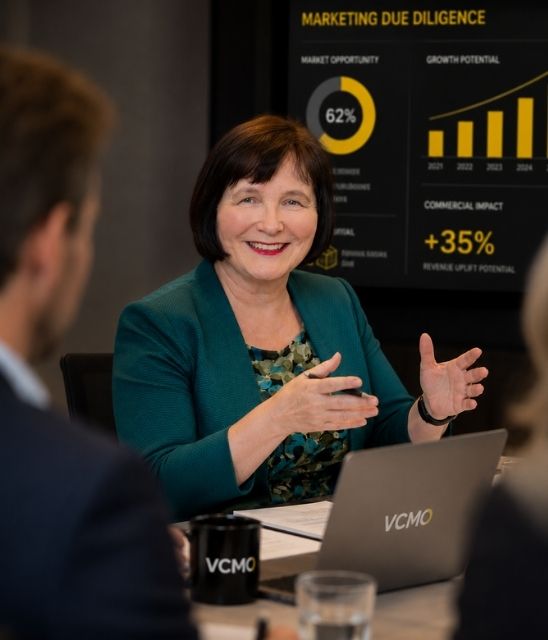
“The leverage in fractional leadership comes from applying senior judgement at the decisions that shape the whole growth system. The objective is not to create more marketing, but to ensure the organisation is investing in the right markets, customers and priorities.”
Ruth Napier - Chartered Fractional CMO
Connecting Marketing Strategy to Business Strategy
Marketing can easily become detached from the ambitions of the business.
Plans may be organised around campaigns, content, events and channel targets while the leadership team is focused on revenue quality, margin, market entry, investor expectations or the next stage of organisational growth.
A Fractional CMO reconnects these conversations.
They translate the business strategy into marketing choices and ensure that marketing objectives reflect the organisation’s commercial priorities. If the company intends to enter a new market, marketing must address positioning, customer evidence, routes to market and the credibility required to compete. If the priority is profitable growth, marketing must focus not only on lead volume but also on acquisition economics, conversion, retention and customer value.
This connection changes the status of marketing within the organisation.
It is no longer treated principally as a communications or campaign function. It becomes part of how the business decides where growth will come from and how that growth will be created.
The Fractional CMO also introduces market and customer evidence into leadership discussions. Assumptions about demand, differentiation or buying behaviour can be examined before the business commits significant resources to them.
This does not remove uncertainty. It gives the leadership team a more disciplined basis on which to act.
Establishing a Scalable Route to Market
Early growth is often driven by founder energy, personal relationships and opportunistic sales.
These strengths can take a business a considerable distance, but they do not always translate into a repeatable growth model. As the organisation scales, it needs to understand which customers are most valuable, why they buy, how demand is generated and how opportunities move through the commercial process.
A Fractional CMO helps convert early momentum into a clearer go-to-market system.
That may involve refining the ideal customer profile, strengthening the proposition, prioritising market segments or clarifying the roles played by brand, demand generation, partnerships and direct sales. It also requires realistic alignment between the demand marketing creates and the organisation’s ability to convert and serve it.
For founders, this can be an important transition.
Marketing can no longer depend on their constant involvement, personal interpretation or ability to intervene in every decision. The organisation needs clearer ownership, repeatable processes and a strategy that others can understand and execute.
A Fractional CMO provides that structure while retaining the pace and pragmatism required in a growing business.

Aligning Marketing, Sales and the Wider Organisation
Growth is rarely constrained by marketing alone.
It is frequently slowed by friction between marketing, sales, product, finance and the senior leadership team. Each function may be working hard, but against different assumptions, priorities and measures of success.
Marketing may optimise for lead volume while sales questions lead quality. Product teams may communicate features that do not address the customer’s most important concern. Finance may see expenditure without a clear connection to commercial outcomes. Leadership may change priorities faster than the marketing team can absorb them.
A Fractional CMO acts as an organisational integrator.
Because marketing sits between business strategy and market reality, its leader must connect customer insight, positioning, demand, sales capacity and commercial performance. The Fractional CMO helps establish shared definitions, common goals and clearer feedback loops between the functions involved in growth.
This alignment reduces organisational drag.
Sales receives more relevant support. Marketing gains better visibility into what happens after a lead is generated. Product teams hear more structured customer insight. Leadership receives a more coherent explanation of performance and the decisions required.
The benefits may not always appear as a single campaign result. They are visible in faster decisions, fewer conflicting priorities, stronger handovers and greater confidence across the commercial system.
Turning Marketing Spend Into Growth Investment
One of the most misleading arguments for engaging a Fractional CMO is that they are simply a cheaper version of a permanent executive.
The financial advantage is more significant than that.
A Fractional CMO allows a business to access experienced marketing leadership without creating a full-time role before the scale and complexity of the organisation justify one. But the larger economic contribution comes from improving how the wider marketing budget is allocated and governed.
Poor marketing leadership is expensive.
Budgets become tied to inherited activities that are no longer questioned. Agencies continue working against weak briefs. Technology platforms overlap or remain underused. Campaigns run without clear decision points. Freelancers and suppliers accumulate around individual needs rather than a coherent operating model.
Recruitment can also become reactive. Businesses may hire several junior marketers when the real gap is senior direction, or appoint specialists before establishing the strategy they are expected to execute.
A Fractional CMO introduces commercial discipline to these decisions.
They review whether expenditure supports agreed priorities, challenge activity that lacks a credible role and improve the briefs, measures and governance applied to suppliers. They can also help the business determine which capabilities should remain external, which should be developed internally and which roles will be needed as the organisation grows.
The goal is not indiscriminate cost reduction. Cutting marketing without understanding its contribution can weaken future demand.
The goal is capital efficiency: ensuring that each significant investment has a strategic purpose, an accountable owner and a reasonable connection to commercial value.
In many organisations, the greatest saving comes from cost avoidance—stopping the wrong campaign, supplier contract, technology purchase or recruitment decision before significant value is lost.
Building a Stronger Internal Marketing Capability
Fractional leadership should not create permanent dependence on an external executive.
One of its most important contributions is the development of the people and systems already inside the business.
Growing companies often employ capable marketers who have been promoted quickly or asked to operate beyond their previous level of experience. They may understand the organisation and its customers well, but lack access to senior coaching, strategic challenge or a clear professional framework.
A Fractional CMO can assess the strengths of the team, clarify roles and identify the capabilities required for the next phase of growth. They provide mentoring, improve planning discipline and raise the quality of briefs, analysis and performance conversations.
They also create an environment in which marketers can make better decisions independently.
This matters because sustainable growth cannot depend on one senior individual. It requires a function with the confidence, competence and structure to continue performing as the business evolves.
The strongest Fractional CMOs leave behind more than a strategy. They leave a more mature marketing capability.

“The long-term return from fractional leadership is visible in the capability that remains. Better decisions become embedded in the team, planning becomes more disciplined and the organisation becomes less dependent on individual heroics.”
Rachael Wheatley - Chartered Fractional CMO
Supporting Growth at Different Stages of the Business Lifecycle
The principles of fractional marketing leadership remain consistent, but the emphasis changes according to the organisation’s circumstances.
Early-stage and scaling businesses
For scale-ups, the priority is often to turn initial traction into a repeatable commercial model.
A Fractional CMO can help establish the go-to-market strategy, clarify positioning, create confidence in customer acquisition assumptions and build a marketing function capable of supporting the next stage of growth. They may also help the founder and board articulate a more credible growth narrative for investors.
Crucially, fractional leadership allows the business to access executive capability before a permanent CMO role is economically or organisationally appropriate.
Established businesses experiencing a plateau
In more mature organisations, the challenge is often that formerly successful approaches no longer produce the same results.
The market may have changed, the proposition may have lost distinction or marketing may have become fragmented across teams and suppliers. A Fractional CMO brings external perspective, diagnoses the constraints and helps the business make more deliberate choices about where future growth will come from.
They can restore strategic direction without automatically disrupting the people and infrastructure already in place.
Businesses navigating change or declining performance
During restructuring, leadership transition, acquisition or commercial decline, marketing can lose direction precisely when clarity is most important.
A Fractional CMO can stabilise the function, protect critical capability and provide an objective assessment of what should continue, stop or change. They can help the leadership team distinguish temporary performance pressure from deeper problems involving market relevance, positioning or customer demand.
In these situations, their immediate role may be less about acceleration and more about restoring control. Sustainable growth becomes possible only after the business has removed the causes of decline and rebuilt confidence in its commercial direction.
Why Fractional Leadership Can be the Right Model Before a Permanent Hire
A Fractional CMO should not be presented as an automatic substitute for permanent leadership.
There is a point at which the size, complexity and strategic importance of marketing justify a full-time executive appointment. The challenge is determining when that point has been reached and what the role genuinely needs to own.
Hiring too early can create unnecessary fixed cost or result in a role designed around current problems rather than the organisation’s future requirements. Hiring too late can leave marketing without sufficient direction during a critical growth phase.
Fractional leadership provides an intermediate model.
The business gains access to experienced judgement while its strategy, team and operating requirements are still taking shape. The Fractional CMO can clarify what the organisation needs, professionalise the function and help define the eventual permanent role.
In this sense, fractional and permanent leadership are not competing models. They can form part of a sensible sequence.
A fractional appointment may resolve a temporary leadership gap, guide the business through a particular inflection point or prepare the organisation to recruit a permanent CMO with greater confidence.
Read more: Download a free copy of The Ultimate Guide to Hiring a Fractional CMO

Measuring the Impact of a Fractional CMO
The impact of a Fractional CMO should ultimately be visible in commercial performance, but revenue alone is an incomplete measure.
Growth outcomes are affected by market conditions, sales capability, pricing, product quality, operational capacity and the length of the buying cycle. Marketing leadership should therefore be measured through both commercial results and the leading indicators that show whether the growth system is becoming stronger.
Relevant measures may include:
- Greater clarity over priority markets and customer segments
- Improved quality and predictability of pipeline
- Stronger conversion through the commercial funnel
- Better customer acquisition economics
- Improved retention or customer value
- Clearer allocation of marketing investment
- Reduced waste across suppliers, technology and campaigns
- Stronger sales and marketing alignment
- More reliable reporting and forecasting
- Increased capability within the internal team
The most important measure will depend on the original brief.
A Fractional CMO appointed to prepare a scale-up for investment should not be assessed in exactly the same way as one asked to restore a declining pipeline or restructure an underperforming marketing function.
Both parties should agree the intended outcomes at the beginning of the engagement and review progress regularly. A credible Fractional CMO should welcome this accountability.
When Should a Business Engage a Fractional CMO?
The right time is usually before the cost of the leadership gap becomes obvious.
Common signals include:
- Growth has stalled despite continued marketing activity.
- The business is preparing to scale, enter a market or launch a proposition.
- Marketing lacks senior representation within the leadership team.
- The founder remains too involved in routine marketing decisions.
- Sales and marketing are pursuing different priorities.
- The board cannot see a sufficiently clear return from marketing investment.
- The internal team is capable but lacks strategic direction.
- Agencies and suppliers are operating without unified leadership.
- A permanent CMO is not yet required or cannot be recruited quickly enough.
- The organisation is preparing for funding, acquisition, restructuring or exit.
Not every business with these symptoms requires a Fractional CMO. A contained issue may be better addressed through a strategic workshop, while broader uncertainty may require a marketing audit before an ongoing appointment is considered.
The important question is not whether the organisation needs more marketing support. It is whether it needs senior marketing leadership.
Conclusion: Sustainable growth comes from a better-managed system
Fractional CMOs help businesses grow by improving the conditions in which growth is created.
They establish strategic clarity, concentrate resources on the most valuable priorities and connect marketing more directly to the commercial direction of the organisation. They align functions, strengthen teams and improve the governance applied to budgets, agencies and performance.
Their value does not come simply from being flexible or less costly than a permanent executive. It comes from applying experienced judgement at a point where the quality of marketing leadership can materially change the organisation’s trajectory.
For a scale-up, that may mean turning founder-led momentum into a repeatable route to market. For an established business, it may mean finding a new source of growth. For an organisation under pressure, it may mean restoring focus and preventing further value erosion.
In each case, the principle is the same.
Growth becomes more sustainable when marketing is not merely active, but strategically led, commercially accountable and integrated into the way the business makes decisions.
For leadership teams questioning whether marketing is sufficiently clear, aligned or accountable, an initial conversation can help determine whether the need is for a focused workshop, an independent marketing audit or embedded Fractional CMO leadership.


Need help with a marketing challenge?
Does this article reflect the marketing context in your business?
Choose the next step that fits your situation — whether you need leadership, an independent review, sharper decisions, or early clarity.



Registered Address: 128 City Road, London EC1V 2NX United Kingdom.
Registered Company No: 14551337. ICO Registration No: ZB519372.
VAT Registration No: 438358272


