


Marketing Due Diligence for Private Equity
An independent assessment of marketing and go-to-market performance for PE firms that need clearer visibility into growth risk, value-creation levers, and leadership gaps.
Built for pre- and post-deal, underperformance, transformation, and exit-readiness situations.






















When marketing becomes an investment risk
Private equity does not need more marketing activity. It needs clearer visibility into whether growth is credible, what is driving or constraining performance, and where intervention is needed.
That usually shows up as:
- Marketing being treated as a black box.
- Unclear links between activity and commercial outcomes.
- Weak visibility into pipeline quality, conversion, retention, or GTM effectiveness.
- Management teams struggling to explain performance credibly.
- Value-creation plans lacking clear marketing and growth levers.
- Board or IC scrutiny increasing while reporting confidence stays low.
In these situations, the issue is not just performance. It is governance.
What is marketing due diligence?
Marketing due diligence is an independent assessment of the market-facing capabilities that generate and sustain revenue.
It examines who the business serves, why customers choose it, how demand is created, what converts into revenue and whether the commercial model can scale without disproportionate increases in cost or complexity.
This is not a channel audit or a review of campaign activity.
A diligence exercise should test whether the growth assumptions supporting valuation and the investment thesis are grounded in commercial reality. It should identify both downside risk and the interventions most likely to create value after the transaction.
The central questions are straightforward:
- Is the target pursuing the right customers and markets?
- Is its proposition sufficiently distinctive and credible?
- Is demand repeatable, or dependent on a narrow set of relationships or channels?
- Are customer acquisition and retention economics attractive?
- Is pricing aligned with customer value and market position?
- Can the current marketing and go-to-market model scale?
- Does the leadership team have the capability to deliver the plan?
- What needs to change first?
The answers are rarely found in one dashboard or management presentation. They emerge by bringing together commercial data, customer evidence, leadership interviews, operational practices and the realities of how the company currently wins business.
When private equity and portfolio leaders use the service
These are the moments when diligence is most useful — not as a reporting exercise, but as a decision tool.

Pre-deal validation
The business has growth potential, but marketing and go-to-market capability need more objective assessment.

The first 100 days require sharper priorities
PE needs a clearer view of which growth levers are real, which are weak, and where leadership attention should go first.
Portfolio underperformance
Pipeline quality, CAC, conversion, retention, or commercial momentum is deteriorating and leadership needs an independent view.

Marketing leadership is missing or too weak
The portfolio company has marketing activity and resources, but lacks sufficient senior leadership or organisational alignment.

Transformation is underway
Repositioning, operating-model change, market entry, or commercial reset requires a stronger view of GTM readiness and risk.

Exit preparation is approaching
The growth story, reporting, and commercial engine need to stand up more credibly to scrutiny.

Reporting lacks enough confidence
There is data and activity in place, but not enough board-level visibility into what is driving performance, what is creating drag, and where intervention is needed.
Portfoliowide comparability
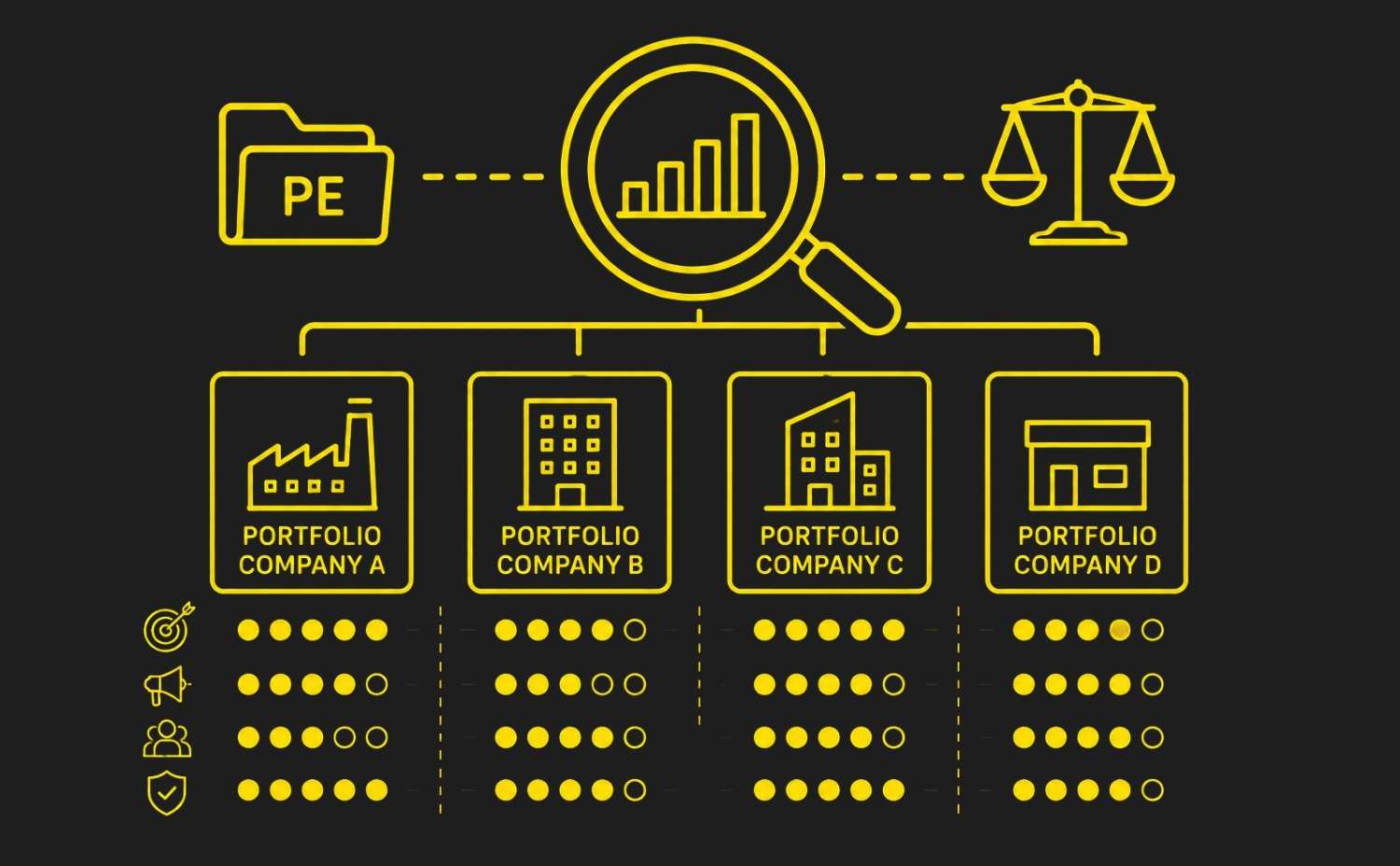
The firm needs a more consistent way to assess marketing and go-to-market maturity, risk, and value-creation potential across multiple assets.

An independent commercial assessment of marketing and go-to-market performance
Our Marketing Due Diligence for PE is a structured assessment of how marketing and go-to-market are contributing to growth, where value is being created or lost, and what needs intervention.
It is not a surface-level review of channels or campaigns. It is an investor-relevant assessment designed to answer questions such as:
- How credible is the current marketing and GTM engine?
- Where is performance being constrained?
- What is waste versus value?
- Are the right growth levers visible and governable?
- Is there a leadership, capability, or operating-model gap?
- What should happen next?
The goal is not simply to assess marketing. It is to help make growth more measurable, defendable, and easier to govern.
.jpg)
What the diligence assesses
- Growth model and GTM logic: Is the route to growth clear, commercially coherent, and aligned to market reality?
- Positioning and market narrative: Does the business have a differentiated and credible story that supports pricing power, conversion, and market confidence?
- Marketing performance and reporting: Are the right metrics in place, and do they provide credible visibility into performance and decision-making?
- Demand generation and conversion effectiveness: Is marketing contributing meaningfully to pipeline quality, conversion, retention, and commercial momentum?
- Leadership, team, and operating model: Does the current setup provide the level of leadership, capability, and governance required?
- Supplier, channel, and spend efficiency: Are agencies, channels, and investments contributing enough value relative to cost and complexity?
- Governance and value-creation readiness: Can marketing performance be governed, prioritised, and reported in a way that supports PE oversight?

What private equity receives at the end of the process
The final output is designed to support decisions rather than add another layer of commentary.
Depending on scope and transaction stage, the work may include:
✓ An executive assessment of marketing and go-to-market risk
✓ A view of the credibility of the existing growth engine
✓ Analysis of customer and revenue-quality signals
✓ Assessment of positioning, pricing and demand generation
✓ Identification of leadership and capability gaps
✓ A prioritised set of value-creation levers
✓ Risks, dependencies and proposed mitigation
✓ Recommendations for the first 100 days
✓ Implications for governance, reporting and accountability
✓ An executive summary suitable for investment committee or board discussion
Findings are differentiated by confidence level. Areas supported by strong evidence are separated from those requiring further validation, enabling the investment team to make decisions with appropriate context.
The objective is a clearer commercial view of what is working, what is vulnerable and where intervention can have the greatest effect.
Built for private equity, portfolio, and leadership teams under scrutiny
These are the key stakeholders we work alongside:

Operating Partners and value-creation teams
When portfolio performance needs clearer growth levers, governance, and marketing discipline.

Deal teams and investment leaders
When management’s growth story, GTM capability, or commercial readiness needs external assessment.

Portfolio CEOs
When PE expectations are rising and leadership needs a clearer view of what to fix, govern, or prioritise.

Complex B2B portfolio companies
When long sales cycles, regulated markets, multiple stakeholders, and reputational risk make generic growth assumptions unreliable.

Why PE clients choose VCMO
✔ Independent senior judgement: We provide an external view of what the evidence supports, where risk sits and what should be challenged.
✔ Commercial rather than channel-led analysis: We focus on growth quality, governance, accountability, and value creation rather than activity metrics.
✔ Experience of complex B2B environments: VCMO is particularly suited to businesses where long sales cycles, multiple decision-makers, regulation and reputational risk make generic growth assumptions unreliable.
✔ Assessment linked to intervention: Findings are prioritised around the decisions facing the investment and management teams.
✔ A bridge between PE expectations and management reality: We help translate the value-creation thesis into realistic marketing and go-to-market requirements.
What happens after the diligence
The diligence can stand alone. Where further support is required, the findings may lead to:
- Sharper value-creation priorities
- Revised board reporting and governance
- A first-100-day commercial plan
- A deeper marketing audit within the portfolio company
- A strategic workshop to align stakeholders
- Mentoring for an existing marketing leader
- Fractional CMO leadership to govern implementation
- Support defining or recruiting the next permanent marketing leader
The appropriate next step depends on what the assessment reveals.
VCMO does not assume that every diligence exercise should lead to a larger engagement. The role of the assessment is to provide clarity, including where the current team is capable of acting without additional support.
Where PE Marketing Due Diligence fits in the service mix
If our PE Marketing Due Diligence service is the wrong place to start, you can also explore:



FAQs
Meet Our Chartered Fractional CMOs




Start with a clearer view of growth risk
VCMO helps private equity firms and portfolio leaders determine whether marketing and go-to-market performance can support the investment thesis.

Call us today on +44 (0)331 630 9395
Book a preliminary conversation to help us understand:
✅ The transaction or portfolio context
✅ The commercial assumptions that require validation
✅ The information currently available
✅ The investment or management stakeholders involved
✅ The timetable and required output
✅ Whether a focused or broader diligence scope is appropriate
If marketing due diligence is not the right intervention, we will say so.

Registered Address: 128 City Road, London EC1V 2NX United Kingdom.
Registered Company No: 14551337. ICO Registration No: ZB519372.
VAT Registration No: 438358272


