


Lorem ipsum dolor sit amet, consectetur adipiscing elit. Suspendisse varius enim in eros elementum tristique. Duis cursus, mi quis viverra ornare, eros dolor interdum nulla, ut commodo diam libero vitae erat. Aenean faucibus nibh et justo cursus id rutrum lorem imperdiet. Nunc ut sem vitae risus tristique posuere.
Marketing Definition of the AIDA Model
The AIDA Model is a marketing and advertising framework that describes four stages through which a potential customer may progress before taking action: Attention, Interest, Desire and Action.
It helps businesses structure marketing communications by considering what customers need to notice, understand and believe before making a purchasing decision. The model is commonly used to plan advertising messages, sales communications, website content and conversion-focused campaigns.
AIDA is one of the earliest marketing communication models, with origins in the work of American advertising and sales pioneer E. St. Elmo Lewis during the late nineteenth century.
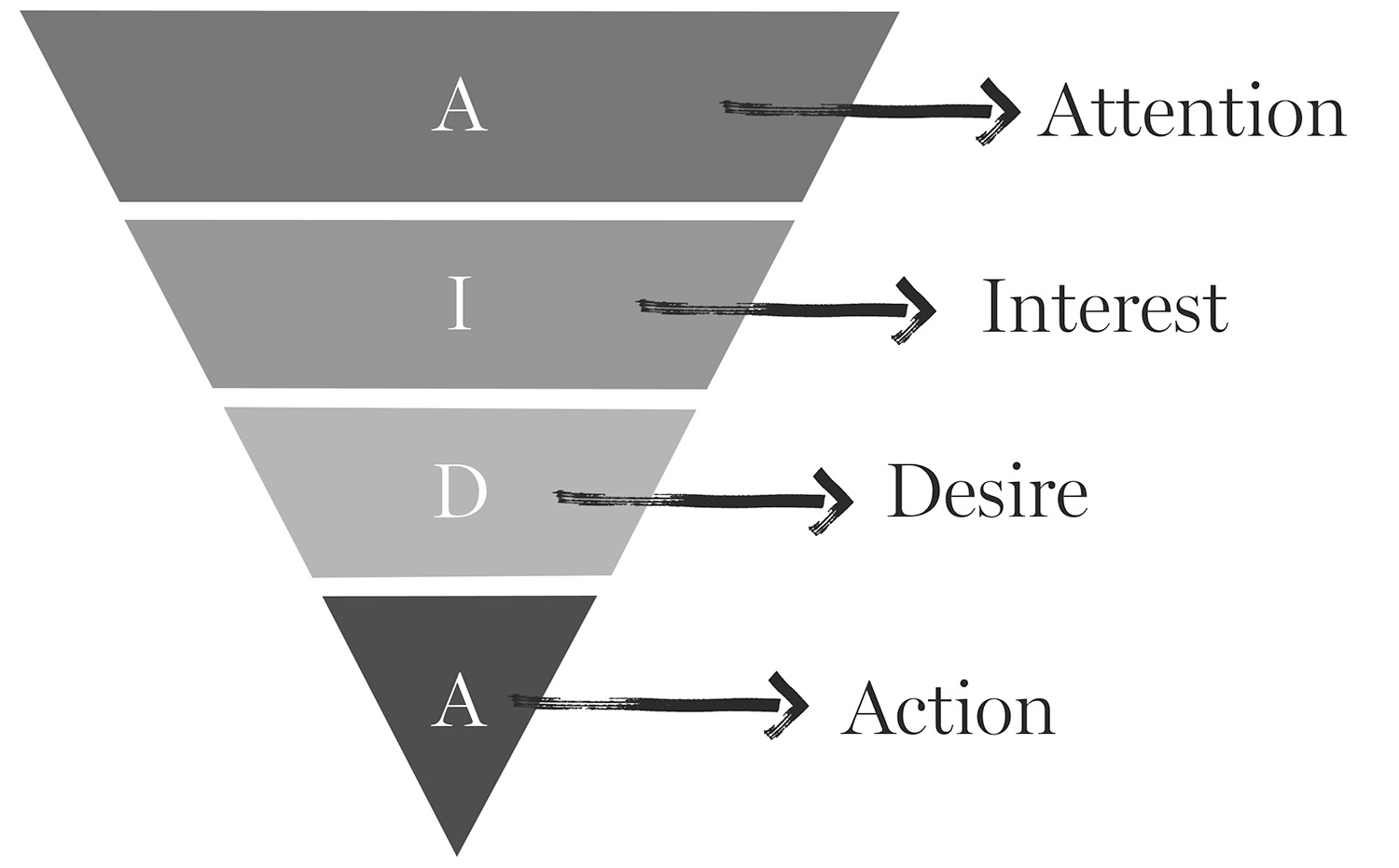
What Does AIDA Stand For?
AIDA represents four interconnected stages of customer response. Each stage addresses a different communication objective.
Some contemporary interpretations use Awareness instead of Attention. Although closely related, Attention emphasises attracting notice, while Awareness describes recognition or familiarity with a brand or offering.
How Does the AIDA Model Work?
The AIDA Model provides a sequence for planning communications that move beyond attracting an audience towards encouraging a specific response.
1. Attention: Attracting the right audience
The first stage involves gaining the attention of people who may have a relevant need for the product or service.
Businesses can achieve this through advertising, search visibility, public relations, social media, events or other communications that introduce their offering to potential customers.
However, attracting attention is only commercially valuable when the audience is relevant. Generating substantial visibility among people unlikely to become customers may create activity without meaningful business results.
Effective communication therefore begins with understanding the target market and the problems customers are seeking to address.
2. Interest: Demonstrating relevance
Once attention has been established, the next objective is to encourage potential customers to explore the offering.
At this stage, communications should explain the problem being addressed, the benefits of the solution and its relevance to customer needs.
Educational articles, product demonstrations, explanatory videos and practical guides can help customers develop a clearer understanding of the offering.
The emphasis shifts from simply attracting attention towards providing information that supports consideration.
3. Desire: Building preference
The Desire stage focuses on helping potential customers understand why a particular offering represents an attractive choice.
This may involve demonstrating commercial value, explaining competitive differentiation, providing customer evidence or addressing concerns about performance and reliability.
In B2B markets, desire is not necessarily emotional enthusiasm. It may reflect growing confidence that a solution can deliver the operational, financial or strategic outcomes the organisation requires.
The objective is to establish a credible preference over competing alternatives.
4. Action: Encouraging a response
The final stage involves encouraging the customer to take a defined action.
Depending on the business model, this might include purchasing a product, requesting a demonstration, booking a consultation, submitting an enquiry or beginning a trial.
Communications should make the next step clear and minimise unnecessary barriers.
However, an action does not always represent a completed sale. In complex B2B purchasing journeys, it may be an intermediate step towards a longer commercial decision.
Why Is the AIDA Model Important?
The AIDA Model encourages businesses to consider the different communication requirements customers may have before taking action.
An organisation may generate substantial awareness but fail to explain why its offering is relevant. Alternatively, customers may understand the benefits but remain unconvinced that the solution is preferable to competing options.
AIDA provides a simple framework for identifying these potential weaknesses.
It can be particularly useful when reviewing website content, developing campaign messages, structuring sales presentations or improving landing-page conversions.
For CEOs and founders, the model also reinforces an important distinction: marketing effectiveness should not be assessed solely through visibility or engagement. Communications need to contribute towards meaningful customer decisions and commercial outcomes.

“The AIDA Model reminds us that attracting attention is only the beginning. Effective marketing must build understanding, establish preference and encourage meaningful action. Visibility alone has little commercial value unless it contributes towards customer decisions.”
Claire Harrison – Chartered Fractional CMO
Example of the AIDA Model In Practice
Consider a hypothetical B2B software company introducing a platform designed to improve inventory management for manufacturers.
Its marketing team could use AIDA to structure a campaign aimed at operations directors.
The sequence helps ensure communications address different customer information needs.
Importantly, customers may enter the process at different stages. An operations director actively searching for inventory management software may already recognise the problem and require detailed product information rather than introductory awareness content.
The model should therefore guide communications without imposing an unnecessarily rigid customer journey.
What Are the Limitations of the AIDA Model?
Although AIDA remains useful, it simplifies the complexity of purchasing behaviour.
Its four-stage structure implies a relatively linear progression, whereas customers often move between stages, compare alternatives, consult other stakeholders and reconsider decisions.
This is particularly relevant in B2B markets, where purchasing decisions may involve finance, procurement, operations and senior leadership.
The original model also ends with Action, meaning it does not explicitly address customer retention, loyalty or advocacy. Some expanded versions incorporate additional stages to recognise the importance of ongoing customer relationships.
AIDA should consequently be understood as a marketing communications framework, rather than a complete representation of the customer journey or a substitute for marketing strategy.
Other frameworks, including the marketing funnel and customer journey mapping, can provide additional perspectives on customer behaviour and the wider buying process.
Key Takeaway
The AIDA Model provides a straightforward way to structure marketing communications around four objectives: attracting Attention, developing Interest, creating Desire and encouraging Action.
Its principal value lies in helping businesses communicate relevant information as customers consider an offering and decide whether to take the next step.
For CEOs and founders, AIDA is a useful framework for evaluating whether marketing communications are doing more than generating visibility and are contributing towards meaningful customer engagement and commercial opportunities.
Need help applying this in practice?
Knowing a marketing term is useful. Knowing what it means for your business is where the real value sits.
If this topic connects to a broader marketing challenge, explore the most appropriate way VCMO can help.



Registered Address: 128 City Road, London EC1V 2NX United Kingdom.
Registered Company No: 14551337. ICO Registration No: ZB519372.
VAT Registration No: 438358272


